
Self-reflection is one of the most valuable skills we can develop. Taking time to understand ourselves, examine our beliefs, and notice our patterns can lead to extraordinary personal growth. It helps us make wiser decisions, build healthier relationships, and live with greater intention.
But there comes a point where reflection quietly stops moving us forwards.
Instead of finding new understanding, we find ourselves thinking about the same problem from the same angles, asking the same questions, and somehow ending up more tangled than when we began. The harder we think, the less certain we become.
If you’ve ever found yourself in that place, you’re certainly not alone.
The good news is that reaching the limits of your own perspective doesn’t mean you’ve failed. Sometimes another pair of eyes simply notices the part of the picture we’ve stopped seeing ourselves.
The Myth of “I Should Be Able to Figure This Out Myself”
Many of us quietly carry around an assumption that sounds perfectly reasonable at first.
“If I just think about this for long enough, I’ll eventually work it out.”
After all, self-reflection is usually presented as something unquestionably positive. We’re encouraged to journal, meditate, question our beliefs, and spend time understanding ourselves. Those are all valuable practices, and they’re ones I encourage too.
The difficulty is that we sometimes confuse more thinking with better understanding.
When we’re deeply invested in a problem, we’re trying to solve it using the very perspective that created the confusion in the first place. We circle familiar thoughts, replay old conversations, imagine different outcomes, and search for the missing piece that will finally make everything click.
Sometimes that works.
Sometimes, given enough time and space, clarity arrives naturally.
But sometimes… it doesn’t.
Instead, our thinking becomes tighter rather than clearer. Many thoughtful people mistake this for progress.
It feels productive because we’re spending so much time thinking. Yet there’s an important difference between exploring an idea and simply walking around the same mental landscape over and over again.
One leads somewhere new.
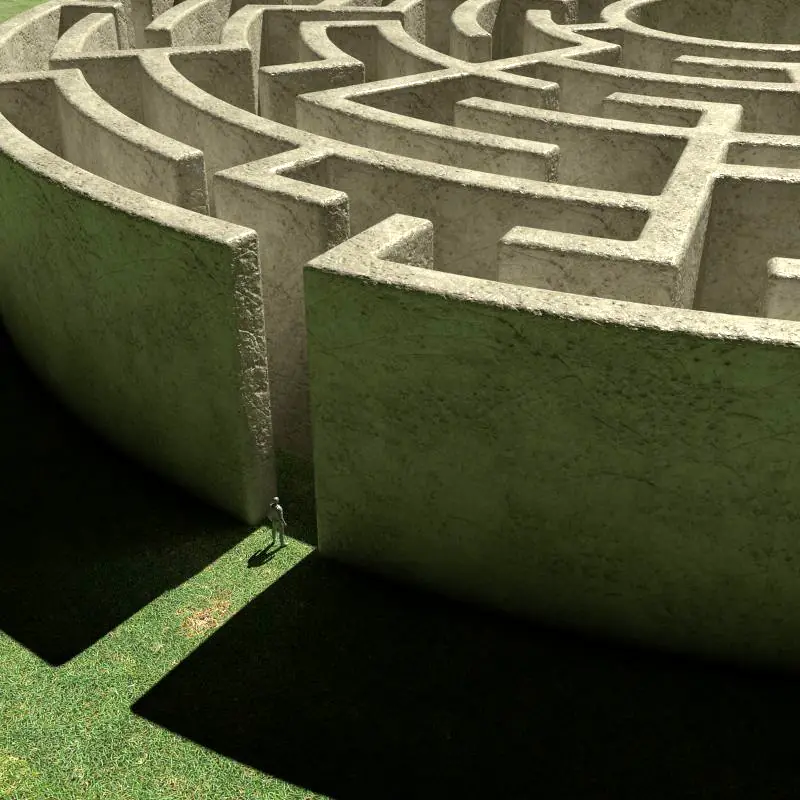
The other slowly becomes a maze.
Perhaps that’s one reason many of history’s wisest thinkers didn’t tackle life’s biggest questions alone. Philosophers sought debate. Scientists invited peer review. Writers relied on editors. Therapists have supervisors.
Not because they lack intelligence.
Because they understand something profoundly human:
We all have blind spots.
No matter how self-aware we become, there will always be parts of ourselves that are difficult to see clearly from the inside.
Recognising that isn’t a weakness.
It’s simply part of being human.
And strangely enough, accepting that can be incredibly freeing. Instead of believing we must untangle every knot alone before we’re “allowed” to ask for guidance, we can begin to see another perspective for what it really is:
Not someone taking over our journey.
Simply someone walking beside us for a while, holding up a lantern where our own light doesn’t quite reach.

When Reflection Becomes Rumination
So how do we recognise the difference between healthy reflection and simply going round in circles?
The line isn’t always obvious.
In fact, from the inside, they can feel remarkably similar. Both involve asking questions, examining possibilities, and trying to understand ourselves more honestly. The difference isn’t how much we’re thinking. It’s whether our thinking is still creating movement.
Healthy reflection tends to leave us feeling more curious. Even when the answers aren’t immediately clear, we gradually develop a better understanding of ourselves. New questions emerge, old assumptions soften, and little pieces begin falling into place.
Rumination feels very different.
The questions don’t really change.
Only the wording does.
One day we’re asking, “Why do I keep ending up here?” The next day it becomes, “What’s wrong with me?“
The wording changes. The circle doesn’t.
Sometimes our minds become so busy trying to solve the puzzle that we stop noticing we’ve stopped making progress.
I think many thoughtful people fall into this trap precisely because they care so deeply about understanding themselves. Curiosity is a wonderful quality – but curiosity eventually has to lead us somewhere. Otherwise it quietly transforms into analysis for its own sake.
One question I sometimes find useful is surprisingly simple:
“Have I learnt something genuinely new over the last week, or have I simply been repeating the same thoughts with different wording?”
That isn’t a question to judge yourself with.
It’s simply a gentle check-in.
Because once we notice we’re walking in circles, we can stop mistaking motion for progress.
Why Perspective Matters
If you’ve ever been completely convinced you’d lost your keys, only for someone else to point out they were sitting on the table beside you, you’ll know how strange perspective can be.
The keys weren’t hidden.
Your brain had simply stopped seeing them.
Life often works in much the same way.
When we’re emotionally close to a situation, we naturally focus on certain details while overlooking others. We all have beliefs, experiences, fears, hopes and habits that quietly shape what we notice and what we dismiss without even realising we’re doing it.
None of that makes us irrational.
It makes us human.
That’s why another perspective can be so valuable.
Not because they know your life better than you do, but because they’re standing somewhere you can’t.
Sometimes a single question from another person is enough to reveal an assumption we’ve never thought to challenge. Sometimes they notice a strength we’ve been overlooking. Sometimes they gently point out that we’ve been asking a question which can never really be answered because it isn’t the right question to begin with.
The goal isn’t for someone else to take over your thinking.
It’s for them to help you think more clearly.
That’s a very different relationship.
If you’ve read my article on Spiritual Discernment: Think for Yourself, you’ll know my goal is never to replace your judgement with mine. It’s to help you strengthen your own.
Because ultimately, the most valuable guidance doesn’t create lifelong dependence.
It cultivates greater awareness.
Over time, many people find they begin recognising their own patterns more quickly. They notice the difference between intuition and anxiety a little more easily. They become better at asking useful questions instead of impossible ones.
Ironically, good guidance often leads to needing less guidance.
And I think that’s exactly how it should be.
Perhaps that’s one reason I’m naturally suspicious of anyone who claims to have all the answers. If someone leaves every conversation believing only the guide can provide the next piece of wisdom, something has gone wrong.
A good guide doesn’t hand you certainty.
They help you cultivate curiosity, perspective and confidence so that, little by little, you become a wiser guide for yourself.
Guidance Isn’t Just for Times of Crisis
When people think about seeking guidance, they often imagine someone at breaking point.
Someone whose life has fallen apart.
Someone facing a major decision or a deep personal crisis.
Sometimes that is exactly where people find themselves.
But it’s far from the only reason to ask for another perspective.
Some of the most valuable conversations happen when life is going reasonably well.
Perhaps you’ve started feeling drawn in a new direction but can’t quite explain why. Maybe you’ve noticed an old pattern quietly resurfacing. Perhaps you’ve grown so much that your current way of seeing yourself no longer quite fits, and you’re trying to understand what comes next.
Those moments deserve attention too.
We don’t have to wait until we’re completely stuck before allowing ourselves to become curious.
In fact, I sometimes think it’s easier to explore new possibilities before life forces us to.
Curiosity tends to be a gentler teacher than crisis.
That applies just as much to spiritual growth as it does to almost every other area of life.
Many people imagine guidance as something we seek only when something has gone wrong.
I see it rather differently.
Sometimes guidance simply helps us understand what’s already beginning to go right.
A fresh perspective can reveal strengths we’ve overlooked, opportunities we hadn’t considered, or quiet changes that have been happening beneath the surface for much longer than we realised.
Growth isn’t always about fixing problems.
Sometimes it’s about recognising possibilities.
You Don’t Have to Solve Everything at Once
There’s another expectation that quietly catches many people out.
It’s the feeling that if we finally decide to seek guidance, we somehow need to make the most of the opportunity by solving everything in one conversation.
I understand that feeling.
When we’ve been carrying questions around for a long time, it’s tempting to bring the entire tangled ball of wool with us and hope someone can patiently unravel every last thread.
But real growth rarely works that way.
A meaningful conversation doesn’t usually provide a complete map of the rest of your life.
More often, it helps illuminate the next stretch of the path.
And that’s enough.
In many ways, personal growth resembles learning any worthwhile skill. No one expects to sit down at a piano for the first time and leave an hour later ready to perform a concerto. Lasting progress is built through foundations, practice and time.
Understanding ourselves works much the same way.
Each genuine insight makes the next one a little easier to recognise. Each thoughtful conversation strengthens our ability to notice patterns, ask better questions and trust ourselves a little more.
That’s one reason I believe good guidance should cultivate awareness rather than dependency.
The aim isn’t to keep handing someone the next answer.
It’s to help them become more confident recognising where to look for their own.
Sometimes the next step is all we need to see.
And once we’ve taken it, the path beyond often begins to reveal itself naturally.

How to Recognise the Moment
So how do you know when another perspective might genuinely be helpful?
There isn’t a checklist. Life is rarely that tidy. But over the years, I’ve noticed a few gentle signs that often suggest someone has reached that point.
Perhaps you’ve been asking yourself the same questions for weeks or months, but nothing really feels different.
Perhaps every possible answer seems to generate three new questions.
Perhaps you’ve become so close to the situation that you can no longer tell which thoughts are helping and which are simply making the tangle tighter.
Or perhaps life is actually going quite well, yet you keep sensing that there’s another layer of understanding waiting just beyond your current perspective.
None of those experiences mean you’ve failed.
They don’t mean you’re incapable of finding your own answers.
They simply suggest that another pair of eyes might help illuminate something you’ve been unable to see from where you’re standing.
Sometimes one thoughtful conversation is enough to reveal a completely new direction.
Not because someone else solved your life for you.
Because they helped you notice something that was quietly waiting to be seen.
Final Thoughts
One of the most comforting realisations I’ve found over the years is that we don’t have to understand our entire journey before taking the next step.
We simply need enough clarity to keep moving.
Sometimes that clarity arrives during a quiet walk.
Sometimes through journalling or meditation.
Sometimes after an honest conversation with a trusted friend.
And sometimes it comes from sitting down with someone whose role is simply to help you explore your own thoughts from a different angle.
None of those approaches compete with one another. They complement one another.
The real question isn’t whether you should be able to figure everything out alone. It’s whether continuing to walk the same circle is still serving you.
Because there comes a point where thinking harder isn’t the answer.
Seeing differently is.
And perhaps that’s what perspective really is:
Not someone handing us a new path.
Simply someone holding up a lantern long enough for us to notice the one that was already there.

Ready to Explore a Fresh Perspective?
If you’ve recognised yourself in this article, perhaps this is one of those moments when another perspective could be genuinely helpful. You don’t have to untangle everything before taking the next step.
Personal Guidance Tarot is designed for exactly these moments. It’s a live video session where we explore whatever feels ready to be understood together – not to hand you all the answers, but to help you see your own path with greater clarity, confidence and curiosity.
Still not sure if Personal Guidance Tarot is the right fit? You’re always welcome to book a free Connection Call first.
Whatever you choose, I hope this article has reminded you of one thing:
Asking for another perspective isn’t a sign that you’ve reached the end of your own wisdom.
Sometimes it’s simply the beginning of seeing it more clearly.
Until next time, keep your heart wild, your ethics strong, and your tea warm.