Have you ever looked up the meaning of a Tarot card and thought, “Well… that’s not particularly helpful”? Perhaps you’ve drawn a card that supposedly means one thing, but when you look at the situation you’re actually asking about, that meaning just doesn’t seem to fit. So you look up another interpretation. And then another. Before long, you’re surrounded by lists of keywords, trying to work out which one you’re supposed to choose.
But what if Tarot isn’t actually a multiple choice test? What if the meaning of a card isn’t something you simply look up, but something you discover by paying attention to the conversation happening between the cards?
In this post, we’ll explore why traditional Tarot card meanings are useful, but only the beginning of Tarot interpretation – and how looking at the bigger picture can completely change the way a reading makes sense.
Where It All Began
I still remember the day I got my first deck of Tarot cards. I was still in school, and my Dad thought it would be an excellent gift for me. He wasn’t entirely sure what they were, but he figured Tarot seemed “weird and witchy” enough to suit my tastes.
He wasn’t wrong.
Little did either of us know that this would be the beginning of a lifelong journey.
Once I’d had a good long look at the cards, I reached for the little booklet that came with the deck. I had absolutely no knowledge of Tarot at that stage, so naturally I assumed the booklet would explain everything I needed to know. Instead, I remember reading through it and thinking:
“Oh no. Really? Is that all?”
Because there was no way that one little paragraph for each of 78 cards could possibly cover the complexities of different people, different situations, different questions and all the different ways those things could interact.
So I did what one did in those days – this was before the internet – and went out and bought a big, fat book about the deck.
Surely that would solve the mystery.
It didn’t.
The book gave me longer explanations, but they were still essentially lists of fixed meanings. Useful, certainly. But they still couldn’t explain how Tarot could possibly account for the almost infinite combinations of people, circumstances, questions, cards and relationships between cards.
I was disappointed.
But I was also fascinated enough to suspect there had to be more to these peculiar little cards.
And then I found a teacher.
Learning the Vocabulary
My teacher had decades of experience with Tarot, and she was willing to take me on as a student. We started, as you might expect, with the basics.
I learned the traditional meanings of the cards. I learned the symbolism. I learned the vocabulary.
And that foundation really does matter.
If you’re learning Tarot for the first time, there is absolutely nothing wrong with beginning with a book or the little booklet that came with your deck. You need somewhere to start, and traditional meanings provide that starting point.
The problem comes when we mistake the starting point for the destination.
Over the next eight-ish years, my Tarot education went much deeper. I learned how to look at symbolism rather than simply memorise what a particular symbol was supposed to mean. I learned how different symbols could interact. I worked through a mountain of anonymised case studies under my teacher’s supervision.
Gradually, I realised that something had changed.
I was no longer simply asking:
“What does this card mean?”
I was looking at the cards and asking:
“What is this card saying here?”
That small change completely transformed the way I understood Tarot.

Learning the Language
There’s a useful distinction between learning vocabulary and learning a language. You can memorise thousands of individual words without necessarily understanding how to have a conversation.
Tarot is rather like that.
You can learn the traditional meanings of all 78 cards. You can memorise keywords, symbols, associations and reversed meanings.
But a Tarot reading isn’t simply a collection of individual definitions.
Once you begin reading a spread as a whole, the cards start interacting. A symbol on one card might suddenly make you notice something on another. Two cards might reinforce one another, contradict one another or provide completely different perspectives on the same issue.
The position of a card matters.
The question matters.
The person asking the question matters.
And the other cards surrounding it matter.
The same card can therefore have very different things to say in different readings.
At some point in my own training, I realised that I’d stopped hearing individual instruments and started hearing the orchestra.
That was when Tarot became really interesting.
The traditional meaning of a card hadn’t become irrelevant. Quite the opposite. It had become part of a much bigger vocabulary that I could use to understand what was happening in front of me.
The meaning was no longer something I simply retrieved from a book.
It emerged from the conversation.
The Meaning Between the Cards
This is one of the things that can be difficult to appreciate when you’re first learning Tarot.
Sometimes the meaning isn’t hidden in the cards.
It’s hidden between the cards.
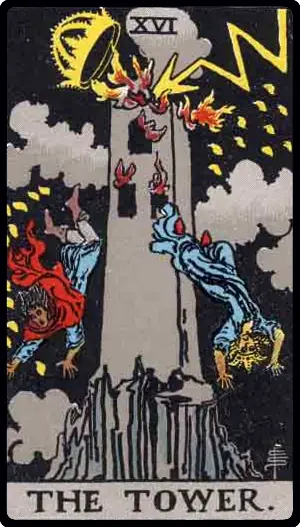
Take the Tower.
Traditional Tarot meanings for this card can include things like upheaval, disruption, adversity, ruin and sudden change. Not exactly the card most people hope to see when they’re already worried about something.
But context matters enormously.
I’ve seen the Tower appear for people in the process of leaving abusive relationships. In that situation, the structures coming down can represent something very different from simple catastrophe.
Someone who has spent years being manipulated and told that they are worthless may finally be reaching the point where those beliefs are beginning to collapse.
The structures that have been built around them are coming down.
And yes, that can be terrifying.
When you’ve spent years being told who you are, discovering that you don’t actually know who you are without those beliefs can be an incredibly frightening place to stand.
But it can also be the beginning of freedom.
The Tower hasn’t changed.
What has changed is the conversation we’re having with it.
This is why I don’t think “scary” automatically means “bad” when we’re talking about Tarot. Death can be frightening. The Tower can be frightening. Change can be frightening. But frightening and harmful aren’t the same thing.
Sometimes something has to end before something else can begin. Sometimes a structure really does need to collapse.
And sometimes something that looks comfortable and safe on the surface is precisely the thing that needs to be questioned.
You simply can’t get all of that from a list of keywords.
Tarot Isn’t a Multiple Choice Test
If we treat Tarot as a multiple choice test, we end up doing something rather odd.
We draw a card, open a book, look at the list of possible meanings and choose whichever one seems most likely to fit. And if that doesn’t quite work, we choose another.
But that’s not really Tarot interpretation. It’s selecting an answer from a list.
This is also why generic card-of-the-day interpretations can only take us so far. A particular card might have a perfectly valid traditional meaning, but the same interpretation isn’t necessarily going to be relevant to every person who happens to encounter that card.
A Tarot reading is personal precisely because the context changes.
The question changes.
The person changes.
The position changes.
The surrounding cards change.
Even the details within the artwork that catch your attention can change.
And that doesn’t mean traditional Tarot meanings are wrong.
They aren’t.
They’re the vocabulary.
But vocabulary is where interpretation begins, not where it ends.
With enough experience, you begin to notice the relationships between things. Perhaps one image echoes another. Perhaps there’s a striking contrast between two cards. Perhaps something in one card suddenly makes sense of something that initially seemed obscure in another. Perhaps a particular symbol catches your attention for no obvious reason, and then becomes surprisingly important as the reading unfolds.
These are the little threads that turn a collection of cards into a conversation.
And that, for me, is where the real fascination of Tarot lies.
Not in finding the one officially correct meaning hidden inside a card, but in discovering what these particular cards are saying in this particular situation.
Final Thoughts
After all these years, I don’t think of Tarot as a test where the cards hand us a correct answer and we’re expected to mark the appropriate box.
I don’t even think every card has one secret meaning waiting to be uncovered.
Instead, I think of Tarot as a language – one made up of images, symbols, patterns, relationships and questions.
And like any language, it takes time to learn how to listen.
That’s also why I think a good Tarot reading doesn’t necessarily leave you saying:
“The Tarot told me what to do.”
I’d much rather hear:
“Oh. I hadn’t thought about it like that.”
Or perhaps:
“I think I finally understand what I’ve been doing.”
That kind of insight can be far more useful than being handed an answer.
If you’d like to explore more about how this approach influences the readings I offer, you might also enjoy Why I Don’t Do Predictive Readings, and What I Do Instead. And if you’re considering having a Tarot reading for the first time, our post about Tarot Ethics is worth a read too – particularly if you’re not sure what to look for when choosing a reader.
Ready to explore Tarot for yourself?
If you’ve never had a personal Tarot reading – or you’ve only encountered Tarot through generic card meanings and readings – our Start Here page is a good place to begin.
We’ll help you find the approach that feels right for you.
Until next time, keep looking beyond the obvious, and remember to listen for what’s happening between the cards.